AI-Powered Lab Workflow Optimization: Strategies To Improve Efficiency

June 5, 2026
Modern healthcare systems are evolving rapidly, and clinical laboratories are at the center of this transformation. With increasing diagnostic demands, rising patient volumes, and the need for faster turnaround times, laboratories are under constant pressure to improve efficiency without compromising accuracy.
This is where Clinical laboratory AI is redefining the future of diagnostics. By integrating intelligent automation, predictive analytics, and digital assistance tools, laboratories are achieving unprecedented levels of operational efficiency.
At the core of this transformation is the AI Health Assistant, a new generation of healthcare technology designed to streamline workflows, reduce human error, and support clinicians with real-time insights.
The Growing Need for Lab Workflow Optimization
Clinical laboratories are essential for diagnosis, disease monitoring, and treatment planning. However, traditional laboratory workflows often struggle with inefficiencies such as:
- Manual data entry and reporting delays
- Sample mismanagement and tracking issues
- High workload on laboratory technicians
- Increasing test volumes with limited staff
- Fragmented communication between departments
These challenges not only slow down operations but can also affect patient outcomes. This is why healthcare organizations are increasingly adopting Clinical laboratory AI to modernize their systems.
By leveraging automation and machine learning, laboratories can eliminate repetitive tasks and focus on higher-value diagnostic work.
What is AI-Powered Lab Workflow Optimization?
AI-powered lab workflow optimization refers to the use of artificial intelligence technologies to improve the speed, accuracy, and efficiency of laboratory processes.
It includes:
- Intelligent sample tracking
- Automated result analysis
- Predictive workload distribution
- Real-time reporting systems
- Decision support systems for clinicians
In this ecosystem, ai-powered healthcare assistants play a critical role by acting as intelligent digital collaborators for healthcare professionals.
These systems are not just tools they are evolving into cognitive assistants that help interpret data, reduce manual effort, and enhance clinical decision-making.
How Clinical Laboratory AI is Transforming Diagnostics
The adoption of Clinical laboratory AI is reshaping how laboratories operate. Instead of relying on manual intervention at every stage, AI introduces automation and intelligence into workflows.
1. Automated Sample Processing
AI systems help laboratories track and manage samples with high precision. From specimen collection to analysis, every stage is digitally monitored to reduce errors.
2. Intelligent Data Management
Laboratories generate massive amounts of data daily. AI systems organize, categorize, and analyze this data efficiently, ensuring quick access and better decision-making.
3. Faster Diagnostic Turnaround
One of the most significant benefits of Clinical laboratory AI is the reduction in turnaround time. AI algorithms prioritize urgent cases and streamline workflow bottlenecks.
Key Strategies for Improving Laboratory Efficiency
To fully benefit from ai-powered healthcare assistants, laboratories must implement structured optimization strategies.
1. Workflow Automation for Routine Tasks
A large portion of laboratory workload involves repetitive administrative work such as documentation, scheduling, and reporting.
AI automation helps:
- Reduce manual workload
- Minimize human errors
- Improve consistency in reporting
- Speed up administrative processes
By integrating an AI Health Assistant, laboratories can automate communication and documentation tasks, freeing up valuable time for technicians.
2. Smart Sample Tracking Systems
Sample mismanagement is one of the biggest challenges in clinical laboratories.
With Clinical laboratory AI, laboratories can:
- Track samples in real-time
- Prevent mislabeling or loss
- Maintain complete chain-of-custody
- Improve traceability and compliance
This ensures higher reliability and improved operational efficiency.
3. Predictive Resource Allocation
AI systems can analyze historical data to predict workload patterns.
This helps laboratories:
- Allocate staff efficiently
- Manage inventory proactively
- Avoid testing backlogs
- Optimize resource utilization
Such predictive capabilities are a key advantage of ai-powered healthcare assistants in modern healthcare environments.
4. Enhanced Diagnostic Accuracy
Human errors in laboratory reporting can lead to misdiagnosis or delays in treatment.
AI helps reduce these risks by:
- Detecting anomalies in test results
- Standardizing interpretation
- Cross-verifying data inputs
- Flagging inconsistencies in reports
This improves trust and reliability in diagnostic processes.
-
Real-Time Decision Support for Clinicians
Modern laboratories are not just data generators, they are decision-support hubs.
An AI Health Assistant enables clinicians to:
- Access real-time lab insights
- Receive automated alerts for abnormal values
- Interpret complex diagnostic data quickly
- Make faster treatment decisions
This significantly enhances clinical efficiency and patient care.
Role of AI Health Assistant in Laboratory Transformation
The AI Health Assistant plays a central role in bridging the gap between laboratory data and clinical decision-making.
It acts as a digital layer that connects:
- Laboratory systems
- Healthcare professionals
- Patient data platforms
By integrating solutions like those offered at AI Health Assistant Platform, healthcare organizations can streamline workflows and improve communication across departments.
Key capabilities include:
- Intelligent task automation
- Data interpretation assistance
- Workflow coordination
- Real-time alerts and insights
This makes it a critical component of modern Clinical laboratory AI ecosystems.
Prefer reading: 7 Ways AI Is Transforming Healthcare: From Diagnosis to Treatment
Benefits of AI-Powered Healthcare Assistants in Labs
Implementing ai-powered healthcare assistants provides measurable benefits for healthcare organizations.
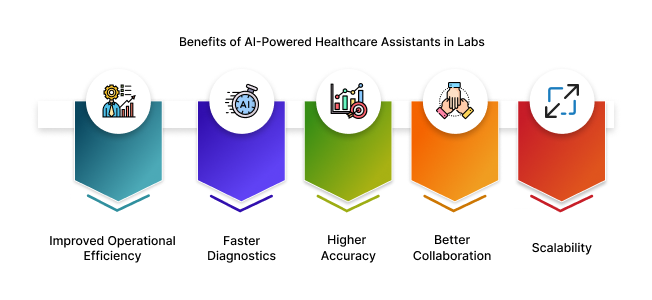
Improved Operational Efficiency
Automation reduces time spent on repetitive tasks and increases productivity.
Faster Diagnostics
AI accelerates data processing and reporting, leading to quicker medical decisions.
Higher Accuracy
Standardized workflows reduce human error and improve consistency.
Better Collaboration
Real-time data sharing enhances communication between lab teams and clinicians.
Scalability
AI systems can handle increasing workloads without requiring proportional staffing increases.
Real-World Impact of Clinical Laboratory AI
Healthcare organizations adopting Clinical laboratory AI are reporting:
- Reduced turnaround times by up to 40%
- Improved diagnostic accuracy
- Lower operational costs
- Enhanced patient satisfaction
These improvements demonstrate how AI is no longer experimental, it is becoming a core part of healthcare infrastructure.
Challenges in AI Adoption (And How to Overcome Them)
Despite its benefits, implementing AI in laboratories comes with challenges:
1. Integration with Legacy Systems
Older laboratory systems may not easily integrate with AI tools.
Solution: Use modular AI platforms that support interoperability.
2. Data Privacy Concerns
Healthcare data must be protected under strict regulations.
Solution: Implement secure, compliant AI frameworks.
3. Staff Training Requirements
Employees may need training to use AI systems effectively.
Solution: Provide structured onboarding and continuous learning programs.
The Future of Laboratory AI
The future of Clinical laboratory AI is highly promising. Emerging technologies such as generative AI, predictive diagnostics, and autonomous lab systems will further revolutionize healthcare.
We can expect:
- Fully automated diagnostic pipelines
- AI-driven disease prediction models
- Smarter ai-powered healthcare assistants
- Integrated global health data networks
Laboratories will increasingly rely on intelligent systems to support both operational and clinical decision-making.
Conclusion
The transformation of laboratory workflows through Clinical laboratory AI is not just a technological upgrade it is a complete shift in how healthcare operates.
By adopting ai-powered healthcare assistants and integrating advanced tools like the AI Health Assistant, laboratories can significantly improve efficiency, accuracy, and patient outcomes.
As healthcare continues to evolve, organizations that embrace AI-driven optimization will remain ahead in delivering faster, smarter, and more reliable diagnostic services.
For more advanced solutions, explore AI Health Assistant Platform and discover how intelligent automation can transform your laboratory operations.
FAQs
1. What is Clinical Laboratory AI?
Clinical Laboratory AI refers to the use of artificial intelligence technologies to optimize laboratory workflows, improve diagnostic accuracy, and enhance operational efficiency.
2. How does AI improve laboratory efficiency?
AI automates repetitive tasks, reduces human error, accelerates reporting, and improves resource allocation in laboratories.
3. What is an AI Health Assistant?
An AI Health Assistant is a digital healthcare tool that supports clinicians and laboratory professionals with automation, insights, and decision-making support.
4. Are ai-powered healthcare assistants safe for clinical use?
Yes, when properly implemented with secure systems, they comply with healthcare regulations and enhance operational safety.
5. What is the future of Clinical laboratory AI?
The future includes fully automated labs, predictive diagnostics, and advanced AI-driven healthcare ecosystems.