AI in Healthcare: 5 Key Trends Shaping the Future of Medical Technology

May 12, 2026
Artificial intelligence is now part of real healthcare infrastructure rather than a concept under testing. Currently, hospitals, diagnostics, insurance companies, and telemedicine apps implement AI in their workflows. The main emphasis has been made on reliability, security, and productivity.
Among those, one can name AI software development solutions for sensitive health data that provide the necessary level of precision and performance, working without breaking any regulations.
In this article, we will discuss the five main trends in the application of AI technology in healthcare from the perspective of implementation in practice.
1. AI Health Assistants Becoming Clinical-Grade Support Systems
The role of an AI Health Assistant has expanded far beyond basic chat interfaces. In modern healthcare environments, it acts as a structured communication and triage layer between patients and medical systems. These assistants are increasingly connected to hospital databases, diagnostic tools, and wearable health devices.
Technically, these systems are built using large language models combined with medical knowledge graphs. These systems have access to organized data such as ICD codes, treatment guidelines, and patient history files, which help them generate relevant answers and not just similar ones. This avoids any confusion that may arise and makes the answer clinically significant.
A typical deployment includes integration with EHR systems using FHIR APIs. This allows the assistant to access real-time patient records securely. When a patient reports symptoms, the system not only responds conversationally but also cross-checks past diagnoses, medications, and lab results before producing a response.
In real deployments, AI Health Assistant systems are used for:
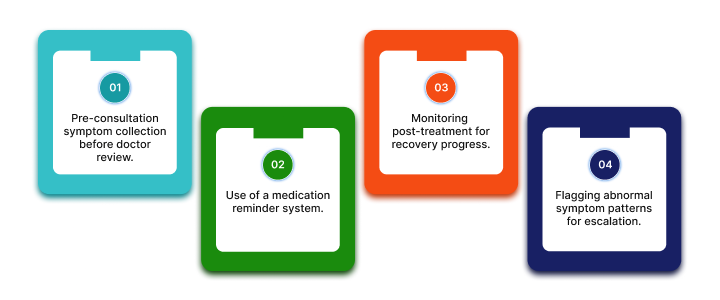
- Pre-consultation symptom collection before doctor review.
- Use of a medication reminder system.
- Monitoring post-treatment for recovery progress.
- Flagging abnormal symptom patterns for escalation.
From an engineering perspective, reliability is maintained through a layered architecture. A rule-based safety layer filters medically unsafe outputs. A retrieval layer ensures responses are grounded in verified clinical sources. A model layer handles natural language understanding.
Healthcare organizations adopting this approach reduce front-desk pressure and improve patient onboarding speed, especially in outpatient departments where volume is high.
2. Predictive Diagnostics Using Multimodal Data Systems
One of the most significant innovations made in AI for healthcare is the adoption of predictive diagnostics based on multi-source data instead of using a single source input alone. In the past, the use of either just lab reports or images alone was common. The current methods use imaging, medical histories, and even genomic data.
These are achieved by developing multimodal deep learning networks. Convolutional neural networks analyze image data like X-ray scans or MRIs. Transformer models analyze the patient’s medical records, including their medical history. Time-series models are used in processing wearable device data, such as heartbeat rate and blood sugar level.
However, what makes all these useful lies in the manner in which the outputs are combined. Feature fusion layers allow the combination of output from all three categories of models to develop a risk factor. This means that a cardiac risk model will integrate ECG data, cholesterol history, and exercise patterns.
From a pragmatic perspective, this allows for:
- The early diagnosis of heart diseases before symptoms appear.
- Identification of cancer risk patterns from imaging plus lab anomalies.
- Prediction of diabetic complications using continuous glucose trends.
- ICU deterioration alerts based on real-time vitals.
Building these systems requires careful data normalization. There are inconsistencies in medical data from hospital to hospital; hence, the need for preprocessing pipelines. Developers usually create ingestion layers for each kind of data separately before consolidating them in the feature store.
The precision of such systems is more dependent on the quality and variety of data rather than the model’s complexity. A well-structured dataset from multiple sources often outperforms a larger but isolated dataset.
3. Clinical Decision Support Systems Becoming Real-Time Diagnostic Tools
Clinical Decision Support Systems (CDSS) are now deeply integrated into hospital workflows. Earlier versions only provided suggestions. Modern systems actively participate in diagnostic reasoning and treatment planning.
A CDSS constructed using AI development solutions generally comprises three basic elements, including a knowledge graph, an inferential algorithm, and a validation component.
A knowledge graph represents the relationships existing between different diseases, their symptoms, drugs used, and the procedures for their treatments. An inferential algorithm is employed to analyze the patient’s data against the knowledge graph for possible outcomes.
In a real hospital workflow, the system operates like this. Patient data is entered into the system either manually or through EMR integration. The CDSS evaluates symptoms against historical cases and generates a ranked list of possible conditions. It also checks for medication conflicts and contraindications before a doctor finalizes treatment.
These systems are used for:
- Supporting diagnosis in emergency departments.
- Detecting drug interactions during prescription.
- Prioritization of high-risk patients during triage.
- Proposing evidence-based treatment protocols.
Explainability is a core requirement. Models must provide reasoning for their outputs. Techniques such as SHAP values or attention visualization are used so clinicians can understand why a recommendation was made.
Without explainability, adoption in clinical environments remains limited regardless of model accuracy.
4. Automation of Healthcare Operations Using AI Software Systems
Operational inefficiency remains one of the biggest cost drivers in healthcare. Administrative work such as billing, scheduling, and documentation consumes significant staff time. This is where AI software development solutions are delivering measurable impact.
In today’s healthcare environment, modern automation solutions leverage OCR, NLP, and rule engines. The input data for these solutions can be medical forms such as prescription sheets, insurance claim forms, and discharge notes, which will be processed through OCR pipelines to transform the documents into digital form.
Once extracted, data flows into automated workflows. Insurance claims are validated against policy rules. Billing entries are generated automatically. Appointment systems adjust schedules based on physician availability and patient priority.
A typical workflow looks like this in production systems:
- A prescription is scanned at the hospital counter.
- OCR converts the image into text.
- NLP extracts structured medical entities.
- A validation engine checks insurance coverage rules.
- The system generates billing and stores the record in EMR.
This reduces manual intervention and lowers processing delays. In many hospital deployments, administrative processing time drops significantly, especially in insurance-heavy workflows.
The problem lies not in the use of automation itself but in error handling. Due to the lack of uniformity of health data, systems need to have built-in backup layers of verification.
5. Federated Learning for Secure and Distributed Medical AI
Data privacy constraints have made centralized AI training difficult in healthcare. Hospitals cannot freely share patient data due to regulatory restrictions. Federated learning solves this problem by changing how models are trained.
Instead of moving data to a central system, models are sent to hospitals where they are trained locally. Only updated model parameters are shared back to a central server. This allows global learning without exposing raw patient data.
In Artificial intelligence development solutions, federated learning is implemented using frameworks such as TensorFlow Federated or PySyft. Secure aggregation protocols ensure that individual updates cannot be traced back to specific institutions.
This approach is used in:
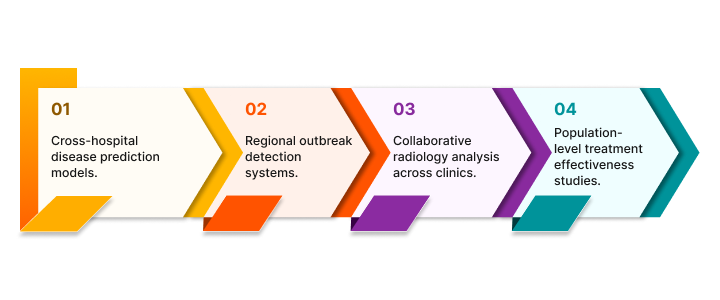
- Cross-hospital disease prediction models.
- Regional outbreak detection systems.
- Collaborative radiology analysis across clinics.
- Population-level treatment effectiveness studies.
The key technical challenge is handling non-uniform data distributions across hospitals. Each institution may have different patient demographics and record structures. To manage this, models are designed to be robust to distribution shifts using normalization techniques and adaptive learning rates.
Federated learning is becoming essential for scaling AI in healthcare across regions without violating privacy laws.
Execution Strategy for Building Healthcare AI Systems
The use of artificial intelligence in healthcare does not solely involve the construction of models. It needs to be done systematically on various levels.
A typical implementation path includes:
- Building standardized data pipelines using FHIR or HL7 formats.
- Developing encrypted storage solutions for data at rest and in motion.
- Training domain-specific models for image processing, natural language processing, and forecasting.
- Integrating AI services into EMR and hospital management systems.
- Establishing monitoring systems for drift detection and model performance.
Each stage requires validation. Medical systems cannot rely on a single deployment cycle. Ongoing assessment is required since patient information and clinical trends change.
Key Challenges in AI Healthcare Adoption
Despite the many advances made, there are also some constraints that inhibit mass usage.
One such limitation is data fragmentation, as most hospitals tend to maintain records in incompatible data formats.
Another problem is the need for regulatory validation of these AI systems before putting them into practice in a hospital setup. The other limitation lies in the cost of infrastructure, which tends to be very high for models involving intensive image processing.
Lastly, the adoption of these tools by clinicians hinges on their trustworthiness.
Conclusion
Artificial intelligence in healthcare is gradually becoming a formal engineering field where precision, adherence to standards, and system integration outweigh experiment-oriented performance.
It is important to note that the potential of artificial intelligence can only be achieved through systems that are able to function within a clinical environment without affecting its processes.
It all comes down to whether organizations are able to adopt efficient AI software development solutions that not only predict, but also execute reliably.
FAQS
What is an AI health assistant in cancer detection?
An AI health assistant is the system that works with clinical data, helping clinicians to detect the patterns related to cancer. It enhances uniformity and minimizes the likelihood of missed signals.
How does an AI medical assistant improve diagnosis?
An AI medical assistant examines imaging, text and structured data to produce risk scores and anomaly alerts. This aids clinicians to pay attention on high-priority cases.
Is a healthcare AI assistant reliable?
Virtual Healthcare Assistants assist in the development of patient communication by monitoring symptoms, providing reminders, and operating communication among patients and care teams.
What role do Virtual Healthcare Assistants play?
Virtual Healthcare Assistants are used to support the inclusion of patients by monitoring their symptoms, providing reminders, and patient-to-provider communications.
Why are AI software development solutions important?
The solutions of AI software development make sure that the AI systems become scalable, secure, and interoperable with the current healthcare infrastructure. Failure of deployment without this foundation.