How AI Health Assistant Enhances Cancer Detection with Smart Insights

May 1, 2026
Detection of cancer is a matter of data as well as an issue of clinical assessment. The diagnosis of cancer involves information derived from scans, pathology results, blood tests, genetic analysis, and the patient’s past medical history for many years before their current state. In the majority of hospitals, these inputs are contained in disparate computer systems. It is the need to manually correlate these disparate sources that causes many cancers to be missed or detected only when they are in later stages.
An AI health assistant resolves this problem by analyzing clinical data on a scale beyond what humans are able to do manually. It reduces blind spots, speeds up interpretation, and standardizes how signals are detected across large patient populations.
This article explains how an AI medical assistant supports cancer detection in real environments, the technical systems behind it, and what changes when a healthcare AI assistant is deployed in production.
Where Traditional Detection Breaks Down?
Cancer diagnosis rarely fails because of a lack of expertise. It fails due to fragmentation and volume. A radiologist may review hundreds of scans in a day. A pathologist might examines dozens of slides with unnoticeable differences. Consistency is influenced by fatigue and information overload, even high-experience.
Another issue is a disconnected context. Imaging results may not be reviewed alongside genetic risk or historical symptoms. This slows down pattern recognition. In early-stage cancers, the signal is weak. Missing it by a few months can change outcomes significantly.
The magnitude of the problem is evident. World Health Organisation estimates 10 million cancer-linked deaths per year.
Earlier diagnosis enhances survival in most types of cancer but particularly breast, lung and colorectal cancers.
What an AI Health Assistant Actually Does in Oncology?
The AI health assistant acts as an intelligent layer between unprocessed clinical data and the physician. This tool collects data from various systems, standardizes the data, and then runs pre-trained models on the data to identify patterns associated with cancer.
A typical system processes:
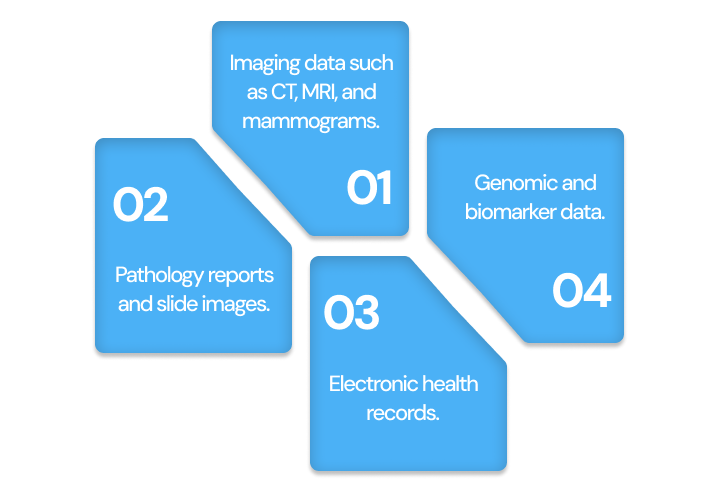
- Imaging data such as CT, MRI, and mammograms.
- Pathology reports and slide images.
- Electronic health records.
- Genomic and biomarker data.
An AI medical assistant then generates outputs such as risk scores, anomaly flags, and diagnostic suggestions. These outputs are not final decisions. They are structured signals that help clinicians prioritize and validate findings.
The key shift is consistency. A healthcare AI assistant makes sure that all cases are considered within identical data trends and thresholds rather than just relying on the personal interpretation.
Technical Architecture Behind AI-Driven Detection
A production-grade AI health assistant is built on multiple layers. Each layer handles a specific function in the data-to-decision pipeline.
Data Ingestion and Normalization
Clinical data comes in different formats. Imaging systems store DICOM files. EHR systems store structured and semi-structured records. Pathology reports often contain free text.
The first step is ingestion and normalization. Data pipelines convert these inputs into standardized formats. Without this step, model accuracy drops due to inconsistent input structures.
Model Layer
The model layer handles detection and prediction. Different models are used for different data types.
- Convolutional neural networks process imaging data.
- Transformer-based models process clinical text.
- Gradient boosting models handle structured risk scoring.
Each model is trained on labeled datasets. For example, imaging models are trained using scans with confirmed diagnoses. This allows them to learn visual patterns associated with tumors.
A study published in Nature showed that AI systems reduced false negatives by 9.4% in breast cancer screening.
Inference and Decision Support
Once models process the data, the system generates outputs in real time. These include:
- Probability scores for malignancy.
- Highlighted regions in imaging scans.
- Alerts for abnormal lab trends.
This is where the AI medical assistant directly supports clinicians. It does not replace review. It focuses attention where it matters most.
Integration Layer
For adoption, the system must integrate with existing hospital infrastructure. This includes EHR systems, radiology platforms, and lab systems.
A healthcare AI assistant that requires separate workflows will fail adoption. Seamless integration ensures that clinicians can use AI outputs within their existing tools.
How AI Health Assistant Changes Daily Clinical Work?
The impact of an AI health assistant becomes clear when you look at daily workflows. It reduces repetitive analysis and improves signal detection across large datasets.
Key Workflow Improvements
- Consolidates patient data from multiple systems into a single view.
- Flags high-risk cases automatically for priority review.
- Reduces time spent on manual image scanning.
- Provides consistent evaluation criteria across cases.
- Supports faster turnaround in diagnostic reporting.
These changes directly affect detection timelines. In cancer care, reducing diagnosis time by even a few days can influence treatment options.
Use Cases Across Cancer Types
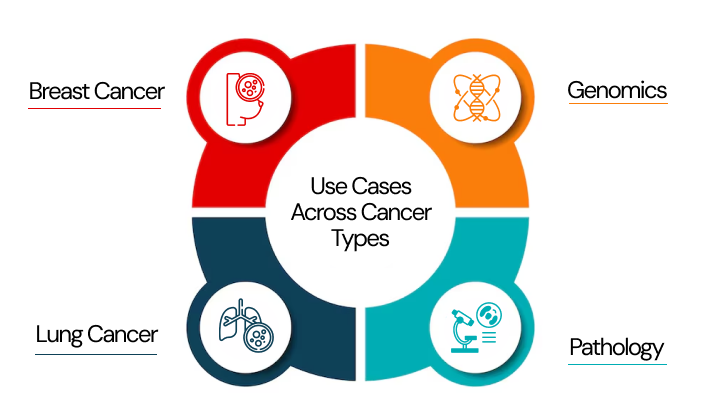
AI systems are not limited to one type of cancer. They are being applied across multiple diagnostic areas with measurable results.
Breast Cancer
AI models analyze mammograms to detect microcalcifications and tissue distortions. These are early indicators that are easy to miss during manual review, especially in dense tissue.
Screening programs using AI report fewer missed cases and more consistent detection rates.
Lung Cancer
Low-dose CT scans are used for early detection. AI systems detect tiny nodules that might otherwise go unnoticed through routine scanning. Early diagnosis of lung cancer increases the chances of survival greatly.
Pathology
The digital pathology system enables slide imaging to be done via AI technology. The AI medical assistant is able to distinguish cancerous cells and calculate the size of tumors.
Genomics
AI systems analyze genetic mutations linked to cancer risk. This supports preventive care and personalized treatment planning.
Role of AI Software Development Solutions
The performance of an AI health assistant depends on how it is engineered. AI software development solutions define how data is processed, how models are trained, and how systems scale.
Key components include:
- High-throughput data pipelines for clinical data.
- Model validation frameworks using real-world datasets.
- Secure data storage with compliance controls.
- APIs for integration with hospital systems.
An inefficient system causes friction. An efficient system integrates seamlessly into the current workflow and enhances it without any disturbance.
The performance of an AI health assistant depends on how it is engineered. AI software development solutions define how data is processed, how models are trained, and how systems scale.
Key components include:
- High-throughput data pipelines for clinical data.
- Model validation frameworks using real-world datasets.
- Secure data storage with compliance controls.
- APIs for integration with hospital systems.
An inefficient system causes friction. An efficient system integrates seamlessly into the current workflow and enhances it without any disturbance.
Virtual Healthcare Assistants in Ongoing Care
Detection is only one part of cancer care. Patients require continuous monitoring and follow-up. This is where Virtual Healthcare Assistants play a role.
They support:
- Tracking symptoms between visits.
- Sending medication and appointment reminders.
- Providing structured patient guidance.
For clinicians, this creates a continuous feedback loop. For patients, it reduces gaps in care. A healthcare AI assistant ensures that relevant updates reach the care team without delay.
Measurable Outcomes from AI Adoption
AI-equipped hospitals have experienced significant progress in their operations and clinical activities.
- Diagnostic accuracy improves by 5% to 15%, depending on the use case.
- Radiology workload can be reduced by up to 30%.
- Reporting turnaround time improves by 20% to 40%.
- Early-stage detection rates increase in screening programs.
Accenture estimates that AI usage in the healthcare industry can cost-save information valued as high as 150 billion every year by 2026.
Implementation Challenges
Implementing an AI medical assistant in oncology should be well planned. The key problems include technical and operational problems.
Data quality is the first issue. Models require clean, labeled datasets. Inconsistent data leads to unreliable outputs.
Regulatory requirements are strict. Systems must meet healthcare compliance standards before deployment.
Model transparency is critical. Clinicians need to understand why a system flags a case. Without this, trust drops.
Integration is not highly rated. Most of the hospitals are operating on legacy systems that are not AI-friendly.
Practical Deployment Approach
Organizations that succeed with AI adoption follow a structured approach.
- Start with a single use case, such as imaging analysis.
- Validate models using real clinical datasets.
- Make outputs interpretable and easy to understand.
- Educate train employees in AI usage and interrogation.
- Continuous monitor performance and update models.
This makes it less risky and enhances adoption in the long run.
Future Direction of AI in Cancer Detection
AI systems will continue to evolve as more clinical data becomes available. The next phase will focus on combining multiple data types into a single model.
This includes:
- Imaging data.
- Genomic data.
- Real-time patient monitoring.
Cloud-based AI software development solutions will make these systems accessible to smaller healthcare providers. This will expand adoption beyond large hospitals.
Conclusion
Detection of cancer needs to be accurate, fast, and deal with complicated data. All three are enhanced by an AI health assistant that organizes data and uses standard analytical models.
An AI medical assistant aids clinicians by detecting patterns that might be overlooked when manually examined. A medical AI assistant takes this to all stages of care, such as patient care.
With strong AI software development solutions and proper implementation, these systems improve diagnostic accuracy, reduce delays, and support better clinical outcomes.
The shift is practical. It is already happening in hospitals and diagnostic centers. The systems that adopt it early are improving both efficiency and patient care.
FAQs
What is an AI health assistant in cancer detection?
An AI health assistant is the system that works with clinical data, helping clinicians to detect the patterns related to cancer. It enhances uniformity and minimizes the likelihood of missed signals.
How does an AI medical assistant improve diagnosis?
An AI medical assistant examines imaging, text and structured data to produce risk scores and anomaly alerts. This aids clinicians to pay attention on high-priority cases.
Is a healthcare AI assistant reliable?
Virtual Healthcare Assistants assist in the development of patient communication by monitoring symptoms, providing reminders, and operating communication among patients and care teams.
What role do Virtual Healthcare Assistants play?
Virtual Healthcare Assistants are used to support the inclusion of patients by monitoring their symptoms, providing reminders, and patient-to-provider communications.
Why are AI software development solutions important?
The solutions of AI software development make sure that the AI systems become scalable, secure, and interoperable with the current healthcare infrastructure. Failure of deployment without this foundation.