How AI-Driven Biomarkers Improve Early Cancer Detection in Modern Healthcare

March 24, 2026
Early cancer detection plays a critical role in improving survival rates and treatment outcomes. In today’s data-driven healthcare environment, medical professionals are increasingly turning to AI in cancer detection to identify diseases at their earliest stages.
Traditional diagnostic methods often rely on imaging and visible symptoms, which may appear only after the disease has progressed. However, advances in artificial intelligence and biomarker analysis are changing this approach. By combining biomarkers for cancer detection with AI-powered systems, healthcare providers can identify subtle biological changes much earlier.
This shift is enabling faster diagnosis, more accurate predictions, and personalized treatment strategies across modern healthcare systems.
What Are Biomarkers for Cancer Detection?
Biomarkers are measurable biological indicators found in blood, tissues, or other body fluids that signal normal or abnormal processes in the body.
In oncology, biomarkers help detect cancer by identifying early biological changes before symptoms become visible.
Common Types of Cancer Biomarkers
- Genetic mutations linked to specific cancers
- Protein levels associated with tumor growth
- Molecular changes in cells
- Circulating tumor DNA (liquid biopsy)
For decades, biomarkers have been used in cancer diagnosis. However, analyzing large volumes of biomarker data manually is complex and time-consuming. This is where AI-driven biomarker analysis provides a major advantage.
How AI Improves Cancer Detection Using Biomarkers
Artificial intelligence enhances cancer detection by analyzing massive datasets with speed and precision beyond human capability.
AI models can identify hidden patterns, correlations, and early abnormalities that may not be visible through traditional analysis.
Key Capabilities of AI in Cancer Detection
- Real-time analysis of biomarker data
- Detection of early cancer signals
- Pattern recognition across large datasets
- Predictive insights for diagnosis
By integrating AI in oncology, healthcare providers can move from reactive diagnosis to proactive detection.
Benefits of AI-Driven Biomarkers in Early Cancer Detection
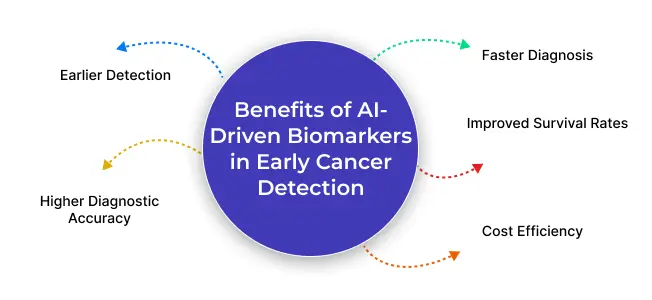
AI-powered biomarker analysis is transforming cancer diagnosis in several ways:
1. Earlier Detection
AI systems can identify microscopic changes in biomarker patterns before symptoms appear, enabling early intervention.
2. Higher Diagnostic Accuracy
AI reduces human error by providing consistent and data-driven analysis, improving diagnostic precision.
3. Faster Diagnosis
Automated data processing significantly reduces the time required to analyze complex medical information.
4. Improved Survival Rates
According to medical studies, early cancer detection can increase survival rates by up to 90% for certain cancer types.
5. Cost Efficiency
Early diagnosis reduces the need for expensive late-stage treatments and hospitalizations.
Role of AI in Personalized Cancer Treatment
Cancer varies from patient to patient based on genetic and environmental factors. AI-driven biomarker analysis enables personalized treatment planning.
Healthcare providers can use AI to:
- Match patients with targeted therapies
- Predict treatment effectiveness
- Monitor disease progression
- Adjust treatment strategies in real time
This approach ensures that patients receive treatments tailored to their specific condition, improving outcomes and reducing side effects.
Real-World Applications of AI in Oncology
AI-driven biomarker analysis is already being used in multiple areas of cancer detection:
- Lung cancer detection through blood-based biomarkers
- Breast cancer screening using AI-assisted imaging and biomarker analysis
- Colorectal cancer detection via genetic markers
- Prostate cancer diagnosis through protein-based biomarkers
These applications demonstrate how AI cancer detection is becoming an essential part of modern healthcare systems.
[Prefer Reading: Healthcare Virtual Assistants: Real-world Applications, Instances, and Advantages]
How AI Platforms Support Early Cancer Detection
Modern healthcare systems are adopting AI-powered platforms to integrate biomarker analysis into clinical workflows.
These platforms help:
- Analyze complex patient data
- Identify early cancer indicators
- Provide clinical decision support
- Improve diagnostic efficiency
Solutions like AIHealthAssistant.pro offer intelligent tools that assist healthcare providers in managing patient data, interpreting diagnostic information, and improving early detection processes.
Challenges in AI-Driven Cancer Detection
Despite its advantages, AI in cancer detection faces several challenges:
Data Privacy and Security
Handling sensitive patient data requires strict compliance with healthcare regulations.
Integration with Existing Systems
Many hospitals face challenges integrating AI tools with legacy systems.
Regulatory Approvals
AI-based medical tools must meet strict regulatory standards before adoption.
Training and Adoption
Healthcare professionals need proper training to effectively use AI systems.
The Future of AI in Cancer Detection
The future of AI-driven biomarkers is highly promising. With continuous advancements in machine learning and data analytics, AI systems are expected to become even more accurate and reliable.
Emerging trends include:
- Multimodal AI combining imaging and biomarker data
- Real-time predictive diagnostics
- AI-powered preventive healthcare systems
- Continuous patient monitoring through wearable devices
Healthcare providers that adopt AI technologies early will gain a significant advantage in delivering faster, more effective, and personalized care.
Conclusion
AI-driven biomarkers are transforming early cancer detection by enabling faster, more accurate, and personalized diagnosis.
By leveraging AI in cancer detection, healthcare providers can identify diseases at earlier stages, improve treatment outcomes, and reduce healthcare costs.
While challenges remain, the integration of AI-powered platforms is helping doctors manage complex data and make informed clinical decisions.
Solutions like AIHealthAssistant.pro are playing a key role in supporting healthcare professionals with intelligent tools that enhance diagnostic workflows and patient care.
As healthcare continues to evolve, AI will become a critical component in building more efficient, data-driven, and patient-centered medical systems.
FAQs
What are AI-driven biomarkers?
AI-driven biomarkers are biological indicators analyzed using artificial intelligence to detect diseases like cancer at an early stage by identifying patterns in medical data.
How does AI help in early cancer detection?
AI helps detect cancer early by analyzing large datasets, identifying subtle abnormalities, and predicting disease patterns before symptoms appear.
What are the benefits of using AI in cancer detection?
AI improves diagnostic accuracy, enables early detection, reduces human error, and supports personalized treatment planning.
Can AI replace doctors in cancer diagnosis?
No. AI acts as a support tool that assists doctors in analyzing data and making better decisions, but it does not replace medical professionals.